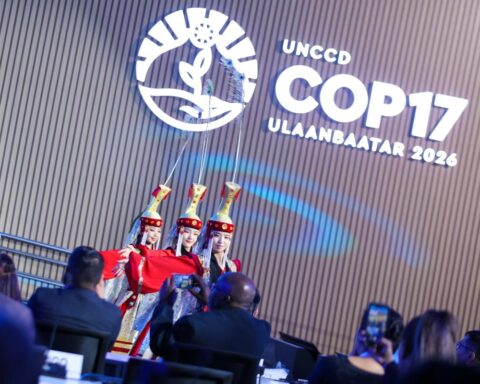

Delegates from 196 countries and the European Union have converged on Ulaanbaatar, Mongolia, for the 17th session of the Conference of the Parties to the United Nations Convention to Combat Desertification, with governments and stakeholders seeking stronger action and financing to tackle land degradation, drought and water scarcity.
The two-week conference, which opened on Monday, is bringing together governments, financial institutions, businesses, scientists, civil society organisations, Indigenous Peoples, pastoralists, local communities, women and youth to advance solutions for land restoration and drought resilience.
The conference is expected to produce decisions and partnerships on drought, rangelands, agricultural lands and soils, resource mobilisation, private-sector engagement and the future strategic direction of the UNCCD.
The discussions are taking place against the backdrop of a worsening global land and drought crisis.
According to the UNCCD, land degradation and drought are estimated to cost the global economy nearly $900bn annually and affect up to 40 per cent of the world’s land and 3.2 billion people.
Droughts have increased by almost one-third since 2000 and now cause at least $300bn in annual economic losses.
As the first of the three Rio Convention COPs holding in 2026, ahead of the biodiversity and climate conferences, COP17 offers an opportunity to strengthen coordination among the UNCCD, Convention on Biological Diversity and United Nations Framework Convention on Climate Change.
The conference is expected to explore how action on land degradation can contribute to addressing interconnected challenges including biodiversity loss, climate change, food insecurity, water scarcity and declining ecosystem resilience.
Opening the conference, Mongolia’s Prime Minister, N. Uchral, called for a shift from international commitments to measurable action on the ground.
“The greatest change we want to see from COP17 is a shift from talk to action, from targets to implementation, and from commitments to measurable results,” Uchral said.
He called for land, climate and biodiversity to be addressed as interconnected challenges rather than separate policy issues.
The Prime Minister also urged greater investment in land restoration and stronger cooperation among governments, international financial institutions and the private sector.
He called for drought resilience to be treated not merely as an environmental issue but as a core component of development policy.
Uchral further stressed the need to place the knowledge and participation of rangeland users, herders and local communities at the centre of global land management policies, while encouraging the deployment of science, technology and innovation to develop practical solutions.
‘COP17 must be a COP of implementation’
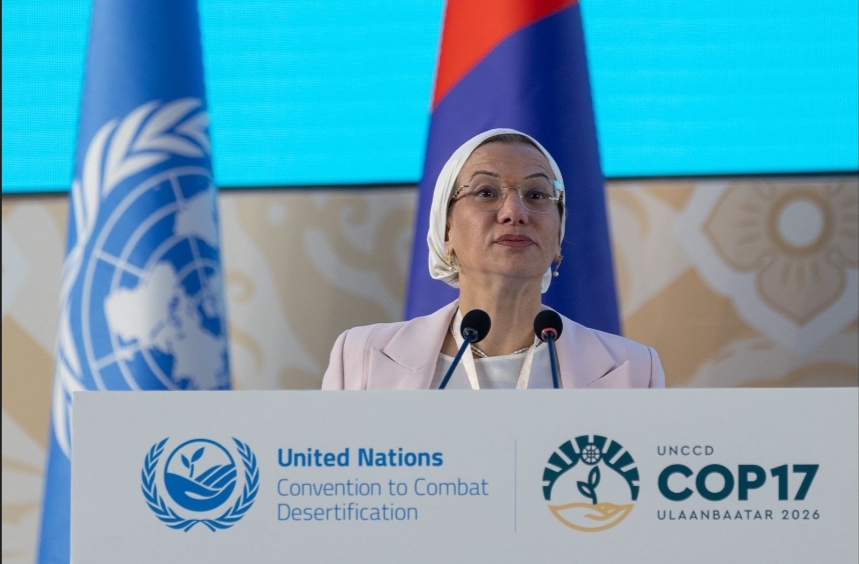
The UNCCD Executive Secretary, Yasmine Fouad, said the consequences of land degradation and drought were already being felt in food systems, water supplies, economies and communities.
“Land degradation and drought are no longer distant environmental concerns. They are already affecting the food we produce, the water we depend on, the resilience of our economies and the ability of communities to build secure futures,” Fouad said.
She said healthy land was the foundation of resilient food systems, economies and societies, stressing that COP17 must focus on implementation.
“COP17 must therefore be a COP of implementation. The world does not lack solutions; the challenge is taking them to scale,” she said.
Fouad said the conference should mobilise political leadership, investment and partnerships to translate existing commitments into measurable results.
She added that restoring degraded land should be viewed as an investment in people, stability and resilience rather than only an environmental obligation.
“At a time when multilateralism is being tested, COP17 is also an opportunity to show that countries can work together to deliver practical solutions that improve people’s lives,” she said.
The Minister for Foreign Affairs of Mongolia and President of COP17, Battsetseg Batmunkh, said the country’s experience had demonstrated the direct connection between land health and people’s livelihoods.
“For Mongolia, land is inseparable from our people, our livelihoods and our future,” Batmunkh said.
She said hosting COP17 provided an opportunity to bring the experiences of dryland countries and pastoral communities into global discussions on land restoration and resilience.
The Minister said Mongolia would work with Parties to promote practical solutions for healthier land, resilient rangelands and a more secure future for communities dependent on land resources.
The Minister of Environment and Climate Change of Mongolia and Chairman of the National Committee for the Organisation of COP17, Sandag-Ochir Tsend, said the conference would seek to turn negotiated decisions into concrete action and investment.
He said desertification, land degradation and climate change were interconnected challenges with implications for food security, economic stability and livelihoods.
Global drought resilience in focus
Drought resilience is one of the major issues on the COP17 agenda.
Building on progress made at COP16 in Riyadh, governments will continue discussions on a global policy framework on drought while examining practical tools, partnerships and financing mechanisms to help countries implement drought management plans.
The discussions will cover preparedness, early warning systems, vulnerability assessments and international cooperation.
More than 70 countries have now developed national drought plans, compared with only three in 2013, according to the UNCCD.
The development is being viewed as evidence of growing recognition that drought should be anticipated and managed before it develops into a humanitarian and economic crisis.
The UNCCD estimates that every dollar invested in drought resilience can generate returns of up to $10, while some nature-based solutions can generate benefits of up to 27 times their cost.
COP17 will feature new tools and partnerships linked to drought preparedness and resilience, including developments around the Riyadh Global Drought Resilience Partnership, Drought Resilience Investment Facility and International Drought Resilience Observatory.
$278bn annual financing gap
Financing land restoration and drought resilience will be another major focus of the conference.
The UNCCD estimates that about $355bn is required annually to address land degradation and drought, while current investment is only around $77bn.
This leaves an annual financing gap of approximately $278bn.
Despite businesses depending on healthy land and reliable water supplies, the private sector currently accounts for only about six per cent of global finance for land restoration and drought resilience.
The UNCCD said public resources alone would be insufficient to bridge the financing gap, making stronger collaboration among governments, development banks, businesses and investors necessary.
COP17 will examine ways to unlock additional financing, reduce investment risks, create incentives for sustainable land management and align public and private investment with restoration and drought resilience priorities.
One initiative expected to feature prominently is Business4Land, which seeks to strengthen private-sector participation in land restoration and drought resilience.
The Business for Land Forum scheduled for August 24 will bring governments, businesses and investors together to accelerate private-sector investment in regenerative landscapes.
Organisations participating in the Action Agenda on Regenerative Landscapes have already committed more than $9bn across more than 210 million hectares, according to the UNCCD.
Rangelands take centre stage
Rangelands are also receiving significant attention at COP17, which is being held during the International Year of Rangelands and Pastoralists.
Rangelands cover about 54 per cent of the Earth’s land surface and support the livelihoods of around two billion people, including approximately 500 million pastoralists.
They produce about one-sixth of the world’s food and provide roughly 70 per cent of livestock feed.
However, up to half of the world’s rangelands are already degraded or at risk, with 78 per cent located in dryland areas facing growing pressure from drought, climate change and unsustainable land use.
Governments are expected to consider a new policy framework on rangelands and pastoralists and launch the Rangelands Flagship Initiative, a global partnership aimed at increasing long-term investment in sustainable rangeland management and strengthening pastoral livelihoods.
The opening of COP17 also marked the conclusion of the UNCCD Silk Road Caravan, a multi-country journey across Eurasia that brought together governments, scientists, pastoralists, local communities and young people.
The caravan visited restoration projects and pastoral communities along the historic Silk Road, highlighting practical approaches to land restoration, sustainable rangeland management and drought resilience.
From Riyadh to Ulaanbaatar
COP17 builds on the outcomes of the 16th UNCCD Conference of the Parties held in Riyadh, Saudi Arabia.
Osama Faqeeha, Deputy Minister for Environment in Saudi Arabia and an adviser to the UNCCD COP16 Presidency, described the Riyadh conference as a turning point in global action on land degradation and drought.
“COP16 in Riyadh was a historical turning point in the global awareness and drive for action to address land degradation and drought,” Faqeeha said.
He said the Riyadh Action Agenda, which had 35 initiatives when launched, had grown to more than 100 initiatives.
He also pointed to increased international cooperation on drought resilience through the Riyadh Global Drought Resilience Partnership and stronger private-sector engagement through the Business for Land Initiative.
Faqeeha said Saudi Arabia would continue working with Mongolia and other partners to maintain the momentum generated in Riyadh.
Four thematic days
Beyond formal negotiations, COP17’s Action Agenda will provide a platform for governments, investors, businesses, scientists, civil society, Indigenous Peoples, pastoralists, local communities, women and youth to showcase practical solutions and establish partnerships.
Four thematic days have been scheduled for the second week of the conference.
Finance Day – August 24: Focused on mobilising public and private investment for land restoration and drought resilience.
Water Day – August 25: Will examine drought resilience and cooperation around the land-water nexus.
Land and People Day – August 26: Will highlight the roles of pastoralists, Indigenous Peoples, local communities, women and youth in sustainable land management.
Food Systems and Soil Health Day – August 27: Will focus on healthy soils, sustainable food systems, food security and resilient livelihoods.
The high-level segment will also feature ministerial dialogues on drought resilience, sustainable rangelands, financing for land restoration, food systems and soil health, migration and security, sand and dust storms and private-sector engagement.
COP17 will host the first formal meetings of the UNCCD Indigenous Peoples Caucus and Local Communities Caucus, alongside the Business4Land Forum, Youth Forum and Gender Caucus.
A Parliamentarians Forum and Mayors Forum will also take place on the sidelines of the conference.
Science and policy reports
Several major scientific and policy reports are scheduled to be launched during the conference.
They include The Economics of Rangelands Restoration on August 24, The Drying Planet: Drought in Numbers 2026 on August 25, the Global Land Outlook for Small Island Developing States and Global Land Outlook Central Asia Thematic Report on August 26, and Soil Health: The Business Case for Investing in Our Foundation on August 27.
The reports are expected to provide evidence and policy recommendations to support governments, investors and other stakeholders in strengthening land restoration, drought resilience and sustainable land management.
What COP17 means for Africa and Nigeria
The issues dominating COP17 have direct implications for Africa, where land degradation, desertification, drought and climate variability are already affecting food production, water availability, pastoral livelihoods and rural economies.
For Nigeria, the outcomes are particularly relevant as communities across the northern parts of the country face desertification, drought, declining soil productivity and pressure on water and grazing resources.
The country’s broader efforts to strengthen food security, restore degraded landscapes and build climate resilience will depend increasingly on access to finance, science, technology and effective land management policies.
The emphasis at COP17 on drought preparedness, restoration finance, sustainable agriculture, healthy soils and resilient pastoral systems therefore offers opportunities for Nigeria to strengthen international partnerships and mobilise resources for vulnerable landscapes and communities.
As negotiations continue in Ulaanbaatar, the central question for governments will be whether the conference can move the global response beyond declarations and commitments towards measurable restoration, stronger drought preparedness and investments that reach communities facing the impacts of land degradation.
COP17 is scheduled to conclude on August 28, when Parties are expected to adopt decisions that will guide the UNCCD’s work over the coming years and shape the next phase of international action on land restoration and drought resilience.
By Dare Akogun