
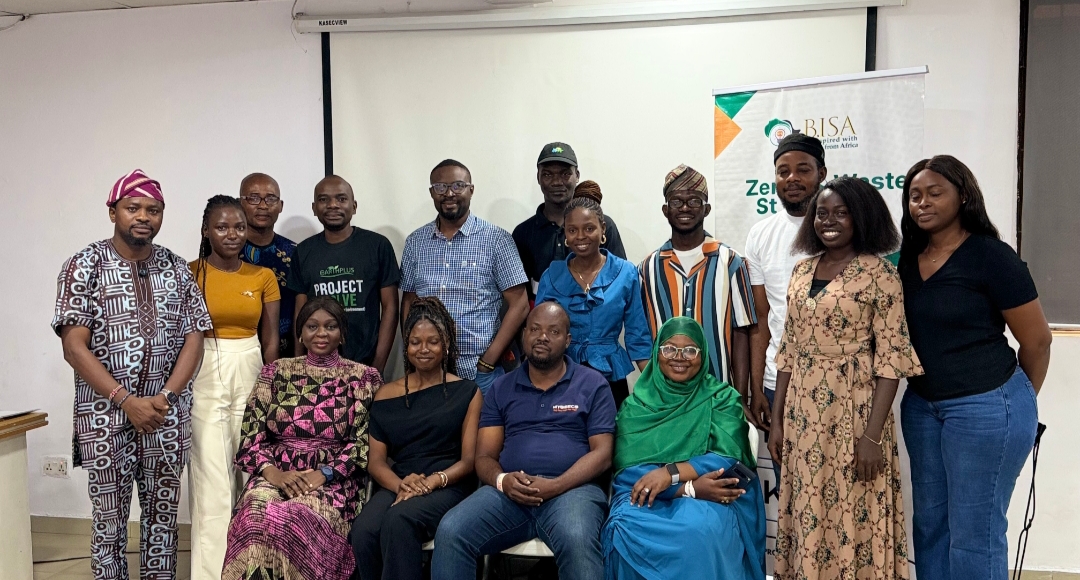
Nigerian organisations working on waste management, plastic pollution and the circular economy have been trained on how to document and communicate practical solutions to environmental challenges in their communities.
The capacity-building workshop was organised under the Zero Waste Stories Bank Phase II Project, an initiative of B.Inspired with Stories from Africa (B.ISA), a storytelling organisation based in Accra, Ghana.
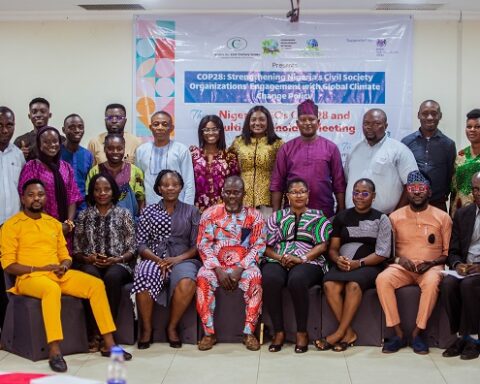
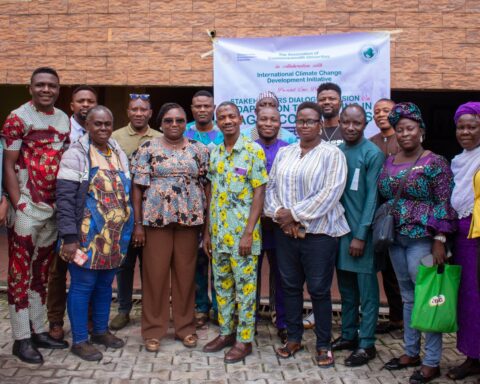
The workshop brought together participants from across Nigeria and focused on equipping organisations with practical storytelling skills to amplify local solutions to waste and environmental challenges and connect them with wider audiences.
The Phase II project builds on the first phase, which engaged organisations in Ghana, Uganda and Botswana, and has now expanded to Nigeria, Kenya and Egypt.
Opening the workshop, the B.ISA representative, Lydia Gyasi, emphasised the importance of documenting local experiences and environmental solutions to ensure that successful Zero Waste initiatives receive wider attention and inspire action.
The opening session was followed by a recap of the virtual training led by a member of the International Climate Change Development Initiative, ICCDI Africa, Maureen Oluwatoyin.
Oluwatoyin revisited key lessons from previous sessions, urging participants to connect environmental storytelling with the realities of Nigerian communities.
She highlighted the importance of identifying the human dimension of environmental challenges, using evidence to strengthen stories and presenting solutions in ways capable of influencing behaviour, attracting partnerships and contributing to policy discussions.
One of the major sessions, titled, “Digital Storytelling & Story Distribution Channels (Local & Global Platforms),” focused on helping participants transform experiences from their communities into compelling digital stories.
The facilitators examined how issues including plastic pollution, open dumping, flooding caused by blocked drainage systems, food waste, poor waste collection and the challenges confronting waste workers could be presented through human-centred storytelling.
Participants were also encouraged to identify their target audiences and select appropriate platforms for distributing their stories.
These included Facebook, Instagram, TikTok, YouTube, LinkedIn, traditional media and international platforms.
The facilitators stressed that choosing the right platform and audience could determine whether a story merely raises awareness or succeeds in influencing policymakers, attracting partners and mobilising communities.
Waste as economic opportunity
Another session, “Circular Economy: Framing Your NGO Story,” was facilitated by the Founder and Executive Director of ICCDI Africa, Olumide Idowu.
Idowu challenged participants to move beyond portraying waste solely as an environmental problem and instead highlight its potential to create jobs, support businesses, improve public health and generate economic value.
Using Nigerian examples, the session examined how organisations could tell stories about recycling, reuse, repair, waste-to-wealth initiatives and sustainable production and consumption.
Idowu emphasised the need for environmental organisations to demonstrate the connection between circular economy interventions, livelihoods and community development when communicating their work.
Participants were also introduced to the Cha Cha Cha Storytelling Training Guide, a practical resource designed to help organisations structure compelling Zero Waste stories.
The guide focuses on key components of effective storytelling, including identifying the challenge, people affected, solution, impact and call to action.
The training included a practical group exercise during which participants developed, filmed and edited short Zero Waste stories using their smartphones.
Working in teams, the participants explored environmental challenges including plastic pollution, open dumping, blocked drainage channels, food waste, recycling livelihoods and innovative approaches to recovering discarded materials.
The exercise enabled participants to apply the storytelling techniques learnt during the workshop by developing strong openings, identifying human-interest elements, presenting problems and solutions, demonstrating impact and ending with clear calls to action.
Some participants said the practical component had changed their approach to environmental storytelling.
One of them, Gloria Ikegbule, said, “The training helped me understand that a waste story should not only focus on the waste but also on the people affected and the people creating solutions.”
Another participant, Kolawole Olumide, said he learnt how to transform everyday environmental problems into stories capable of reaching policymakers and young people.
“I learned how to turn an everyday problem like plastic pollution in my community into a story that can reach policymakers and young people,” he said.
For Halimot Raji, the session on the circular economy changed her perception of waste and its potential to support livelihoods.
“The circular economy session changed how I see waste because it showed me that what we throw away can become an opportunity for livelihoods and innovation,” she said.
Joseph Oni said the practical filming exercise had demonstrated that organisations did not necessarily need expensive equipment to document environmental solutions.
“The practical filming exercise gave me the confidence to use my phone to document solutions happening in Nigerian communities rather than waiting for expensive production equipment,” he said.
The workshop ended with an awards ceremony to recognise participants and organisations that demonstrated strong engagement and creativity throughout the training.
Brahamot Global Enterprise emerged as the best-performing company and received a $100 award for its outstanding contribution to the activities.
The organisers said the recognition was part of efforts to encourage organisations to continue documenting and communicating solutions to environmental challenges.
The workshop reinforced the message that Nigeria has communities, individuals and organisations developing practical responses to waste, plastic pollution and other environmental problems, but that many of these interventions require stronger documentation and communication to gain visibility.
The organisers said effective storytelling could help organisations attract partnerships, influence policy, encourage behavioural change and connect local environmental solutions with the global Zero Waste movement.
The Zero Waste Stories Bank Phase II project builds on the experiences of Ghana, Uganda and Botswana under Phase I, while extending storytelling capacity-building to organisations in Nigeria, Kenya and Egypt.
The workshop was implemented by ICCDI Africa through B.ISA, with support from the UMI Fund.
By Dare Akogun