
On the surface, a fishing trawler entering Nigerian waters may appear to belong to one company, fly the flag of another country, and be operated by a crew from several different nations.
But investigators say the real owner, the person making millions from the vessel’s activities, often remains invisible.
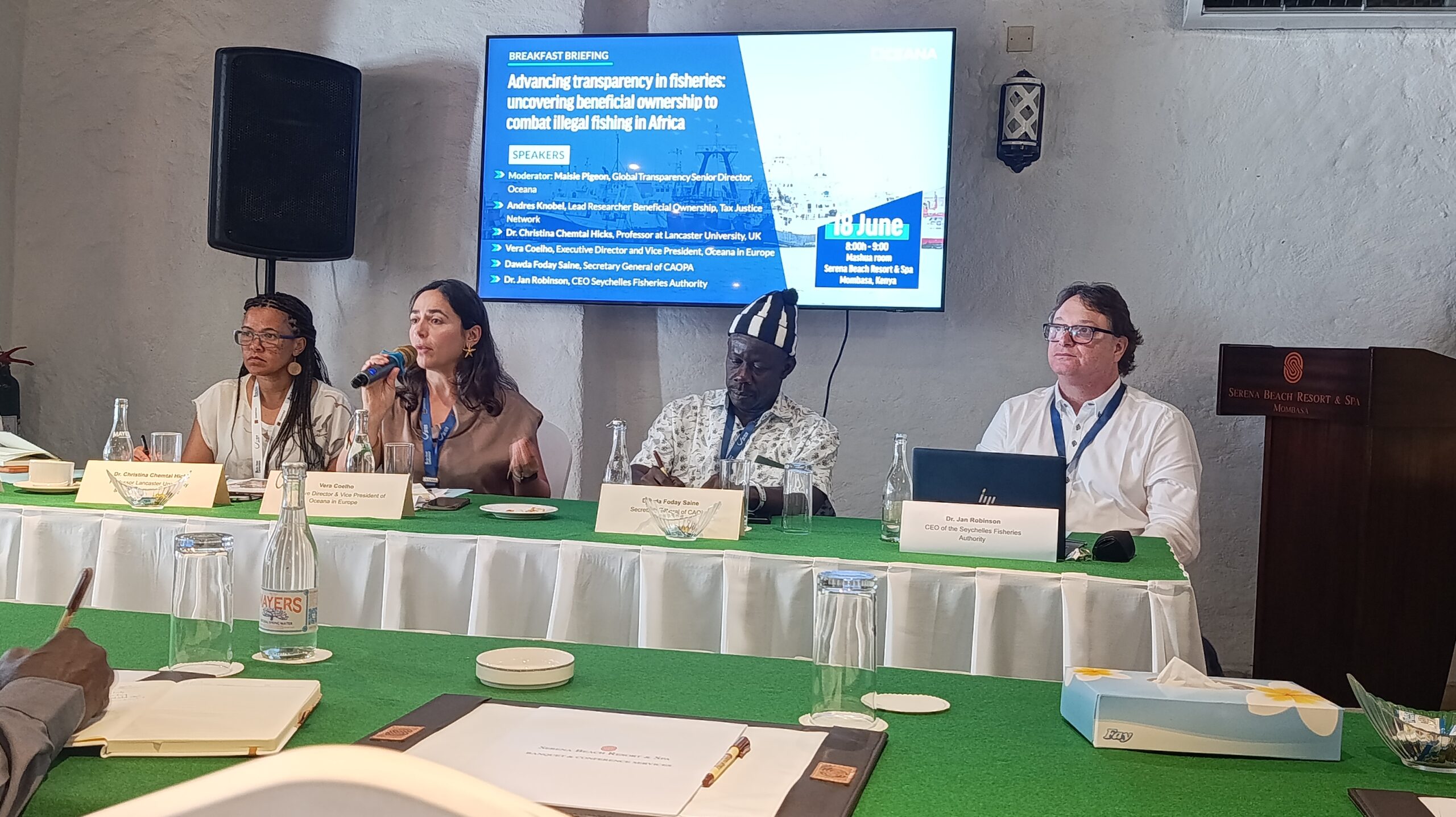
The issue took centre stage at the 11th Our Ocean Conference in Mombasa, Kenya, where governments, researchers, and conservation organisations warned that unless countries expose the real individuals profiting from industrial fishing fleets, Africa’s efforts to protect its fisheries and build a sustainable blue economy will remain severely undermined.
For Nigeria and many coastal African nations already battling dwindling fish stocks, food insecurity, and rising youth unemployment, the warning could hardly be more timely.
A crime hidden in plain sight. Illegal, unreported, and unregulated fishing, commonly known as IUU fishing, has long been described by the Food and Agriculture Organisation as one of the greatest threats to marine ecosystems.
But experts say the crime extends far beyond stealing fish.
According to new reports released by Oceana and international researchers during the conference, illegal fishing has become deeply intertwined with organised crime, including money laundering, tax evasion, human trafficking, forced labour, drug trafficking, arms smuggling, and wildlife crime.
Oceana is the world’s largest international ocean conservation organisation, dedicated exclusively to protecting and restoring marine ecosystems through science-based advocacy, policy reform, strategic investigations, and campaigns to combat illegal fishing, overfishing, and marine pollution.
The report revealed it is this hidden network of beneficial owners, operating behind shell companies, offshore registrations, and “flags of convenience”, that global marine experts now identify as one of the biggest obstacles to ending illegal fishing in Africa.
Yet prosecutions remain rare. The reason, experts argue, is simple. Authorities often arrest captains or crews while the wealthy individuals financing and directing the operations remain safely hidden behind complex corporate structures.
Marine governance experts say enforcement agencies have traditionally focused on vessels. However, the real question should be: Who ultimately owns the vessel?
That individual is known as the beneficial owner, the natural person who ultimately controls, profits from, and makes decisions about a fishing vessel, even when their name never appears on official registration documents.
According to Oceana’s investigation, many beneficial owners deliberately conceal their identities using elaborate corporate arrangements spread across multiple jurisdictions.
Some vessels are registered in countries with weak oversight despite having no operational links there. Others frequently change names, ownership documents, and national flags to avoid sanctions or enforcement actions. Industry experts describe the practice as creating a legal maze designed to frustrate investigators.
Nigeria’s waters remain vulnerable
Although the report covered Africa broadly, its implications resonate strongly in Nigeria, a country that possesses one of West Africa’s largest coastlines and one of the continent’s most valuable fisheries.
The sector supports millions of livelihoods through artisanal fishing, fish processing, transportation, and seafood trading.
Yet local fishing communities have repeatedly complained about industrial vessels allegedly encroaching on restricted fishing zones reserved for small-scale fishermen.
Conservation groups estimate that illegal fishing costs African countries billions of dollars annually through lost revenue, depleted fish stocks, and weakened food security.
Experts at the conference warned that without identifying beneficial owners, sanctions imposed on offending vessels rarely deter repeat offenders.
Instead, vessels simply change names, switch flags, or re-register under new companies while continuing operations.
West Africa bears the burden
A Professor at Lancaster University, Pew Marine Fellow, and Oceana Board Member, Dr Christina Chemtai Hicks, warned that the consequences fall disproportionately on West African communities.
According to her, foreign interests continue to dominate access to African fisheries through opaque ownership structures.
She said greater transparency would help prevent foreign companies from monopolising fishing grounds while protecting local livelihoods.
Dr Hicks added that beneficial ownership disclosure would also reduce the use of shell companies, vessel renaming, and flag switching to evade regulations. flags that hide identities
One of the most controversial practices highlighted in the reports involves the use of “flags of convenience.” Under international maritime rules, ships may register under countries other than where their owners reside.
While legal, critics argue that some jurisdictions maintain weak oversight, allowing foreign operators to exploit regulatory loopholes. Researchers found numerous vessels operating in African waters under such flags, making it difficult for authorities to determine who ultimately controls them.
Without that information, prosecution becomes significantly more complicated. Experts stressed that illegal fishing is no longer simply an environmental issue. It increasingly represents a governance challenge affecting national security, public revenue, and rural development.
The depletion of fish stocks threatens food supplies for millions of Africans who depend on fish as their primary source of animal protein.
Meanwhile, governments lose taxes, licence fees, and export revenues. For coastal youths, declining catches also translate into rising unemployment, migration pressures, and economic hardship.
During the conference, Oceana urged governments to adopt four immediate reforms. These include requiring beneficial ownership information for all fishing vessels, making ownership records publicly accessible, strengthening cooperation among enforcement agencies across borders, and maintaining updated public registers of vessels authorised to fish within national waters.
According to Oceana’s Executive Director and Vice-President in Europe, Vera Coelho, transparency represents the foundation of effective fisheries governance.
She said those responsible for illegal fishing continue to profit because governments often cannot identify who truly owns and controls vessels.
Without transparency, she warned, those orchestrating environmental crimes remain insulated from accountability while legitimate fishers suffer unfair competition.
A test for Africa’s blue economy
The debate comes as Nigeria and several African countries pursue ambitious blue economy strategies aimed at expanding marine transport, fisheries, tourism, and coastal industries.
However, delegates at the Our Ocean Conference repeatedly stressed that sustainable growth will depend not only on attracting investment but also on strengthening governance.
For Nigeria, which recently announced major investments in maritime infrastructure and port modernisation, experts say beneficial ownership transparency represents another essential pillar.
Without knowing who controls fishing fleets operating in its waters, they argue, protecting marine resources may prove impossible.
By Dare Akogun
This story was produced as part of the 2026 Our Ocean Conference Fellowship, organized by Internews’ Earth Journalism Network