
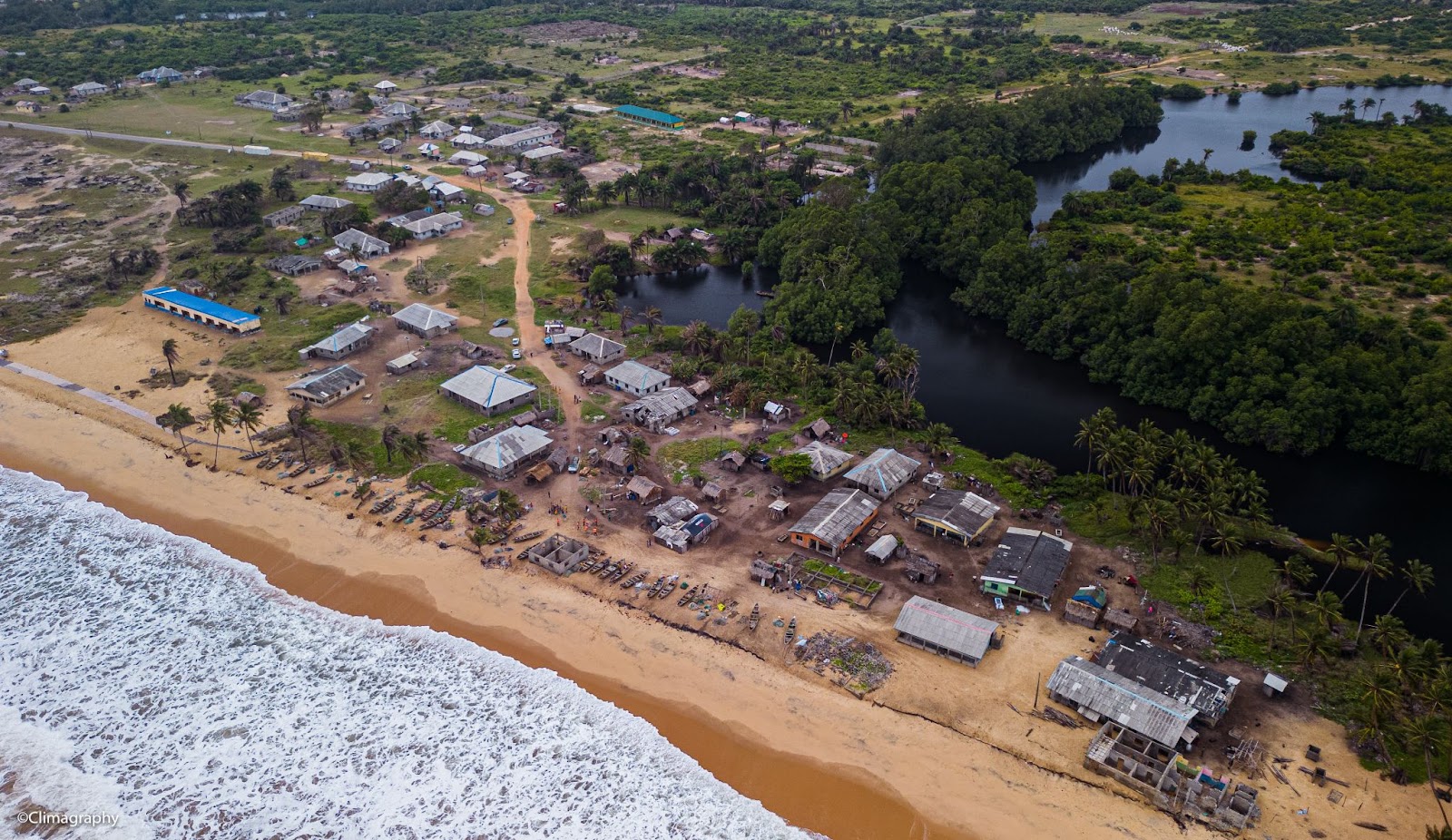
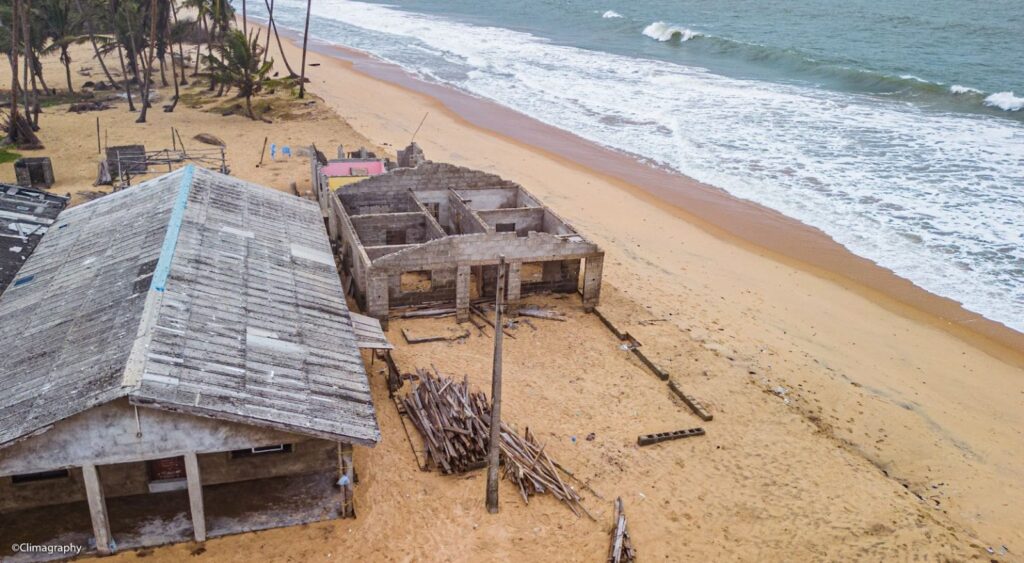
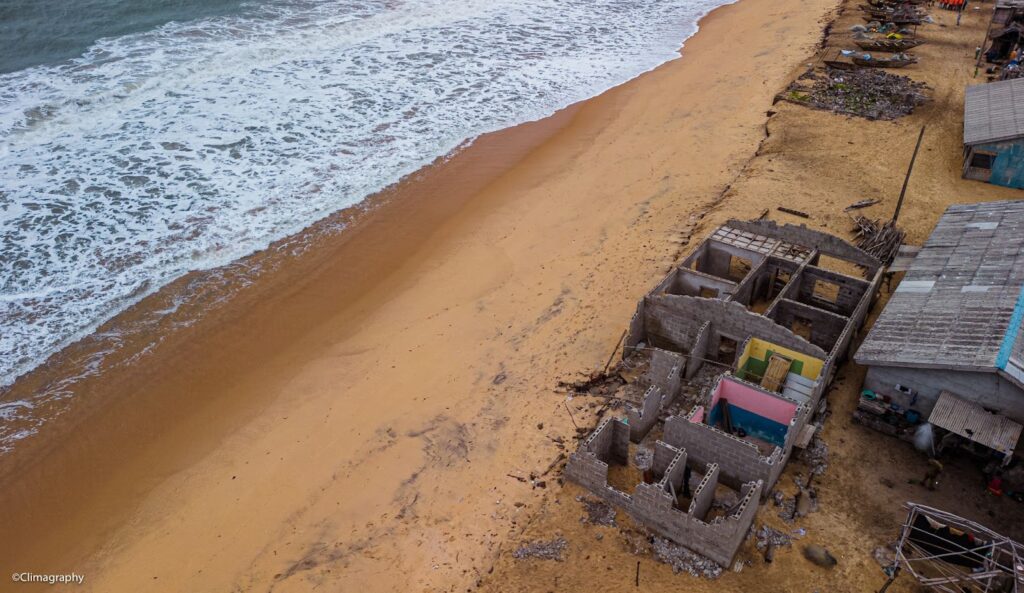
What was once a thriving coastal community in Ibeju-Lekki Local Government Area of Lagos State is gradually being swallowed by the sea, with abandoned buildings, damaged infrastructure, destroyed farmlands and displaced residents bearing testimony to the growing impact of coastal erosion, ocean surges and flooding.
A visit to parts of Akodo-Ise revealed the scale of the devastation, with structures that once formed part of the community now standing deserted, partially buried or dangerously close to the advancing shoreline.
Electrical infrastructure has been damaged, burial grounds have been affected, while some buildings have been abandoned after repeated flooding and erosion made them unsafe for habitation.
The situation has raised fresh concerns about the vulnerability of Lagos’ coastal communities to the impacts of climate change, particularly rising sea levels and increasingly intense coastal flooding.
Walking through the affected sections of the community, the destruction was difficult to miss.
Structures that were once homes and centres of community life now stand as remnants of what was once a vibrant settlement.
In some areas, the advancing sea has eaten deep into the community, leaving residents to abandon properties and relocate to safer areas.
Akodo-Ise, located in the eastern part of Lagos State, is one of several coastal communities facing growing threats from erosion, flooding and ocean surges.
Its vulnerability is particularly striking because of its proximity to some of the state’s major economic infrastructure.
Only a few kilometres from the affected community is the Lekki Free Trade Zone Road, while other major landmarks in the wider area include the La Campagne Tropicana beach resort, the Lekki Deep Sea Port and the Dangote Refinery.
Yet, despite the economic transformation taking place around the area, sections of Akodo-Ise are struggling to survive the changing coastal environment.
‘The sea took our farmland overnight’
During a visit to the community, the traditional ruler, the Baale of Akodo-Ise, recounted the devastating impact of the encroaching sea on residents.
Walking alongside the remains of what was once his palace, the monarch recalled how his coconut farmland was destroyed after the sea surged into the community.
“What used to be my coconut farmland was destroyed when the sea surged into the community,” the monarch said.
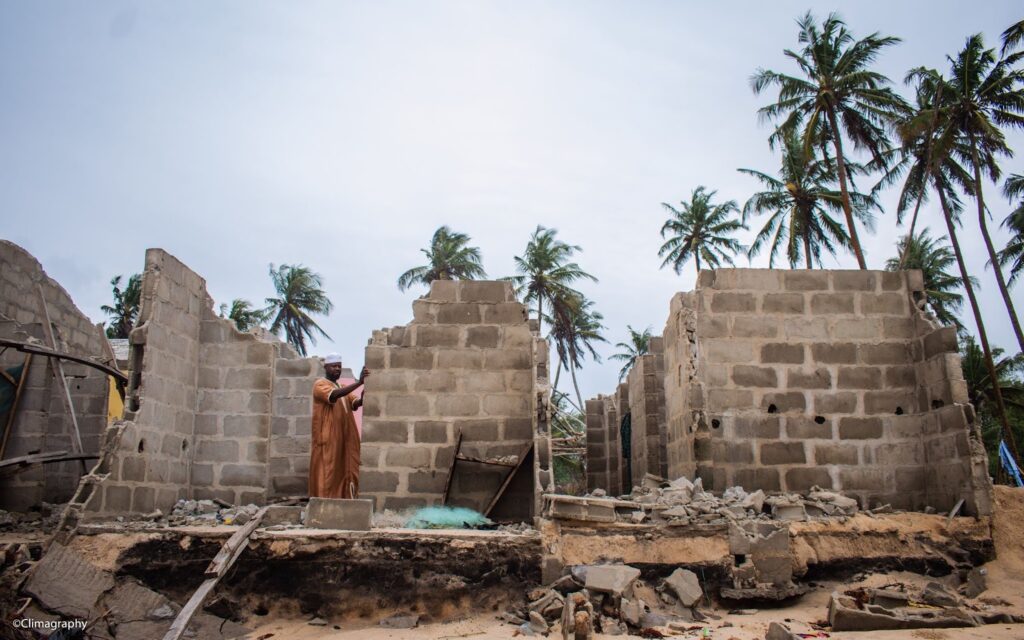
“That used to be our community primary school,” said another community leader, Wasiu Aremu, pointing to some affected structures close to the edge of the ocean. He explained how after losing their homes, many residents were left with no choice but to leave the community. What used to be a serene environment and bubbling economy, thriving on rich fishing activities, is now a shadow of itself.
The repeated flooding and erosion eventually forced him to abandon his home and relocate.
For residents whose livelihoods depended heavily on farming and fishing, the consequences have extended beyond the loss of property.
The destruction of farmland has reduced agricultural activities, while damage to fishing areas and vessels has affected one of the community’s traditional sources of income.
The economic consequences are particularly severe for households that lack the resources to relocate or rebuild.
Pointing towards an area close to the shoreline, another community leader said, “That used to be our community primary school.”
The school, according to him, is among the structures lost as the sea gradually encroached on the community.
With homes and community facilities disappearing, many residents have been forced to leave.
What was once described as a serene community with a vibrant fishing economy has increasingly become a shadow of its former self.
Climate change adds to coastal vulnerability
The situation in Akodo-Ise reflects a broader challenge confronting Nigeria’s coastline.
Lagos, with its extensive coastline along the Atlantic Ocean, is naturally vulnerable to coastal flooding, erosion and storm surges.
But environmental pressures have been compounded by rapid urbanisation and development, inadequate drainage in some areas, poor waste management and the degradation of wetlands that traditionally provide natural protection against flooding.
Climate change is adding another layer of risk. Rising sea levels threaten to increase the frequency and severity of coastal flooding, while changing weather patterns and extreme rainfall can worsen flooding in already vulnerable communities.
For communities such as Akodo-Ise, the impacts are not merely environmental. They are also economic and social, when homes are destroyed and families are displaced.
When farmlands disappear, livelihoods are lost; when fishing grounds and equipment are damaged, household incomes decline.
And when schools, roads, electricity infrastructure and burial grounds are affected, the very fabric of community life begins to unravel.
The plight of Akodo-Ise also highlights a difficult contradiction in Lagos’ coastal development. While massive infrastructure projects and private investments continue to transform the Lekki-Ibeju axis, some neighbouring communities remain exposed to the destructive forces of nature.
The proximity of Akodo-Ise to major economic developments makes its vulnerability particularly significant. The community sits within an area witnessing rapid industrialisation, infrastructure development and tourism-related investment.
Yet, the coastal settlement continues to confront basic environmental challenges that threaten its survival. This raises questions about how coastal communities are incorporated into long-term development and climate adaptation planning.
Experts and environmental advocates have repeatedly argued that coastal development must take account of changing climate risks, including sea-level rise, erosion and storm surges. For communities already experiencing these impacts, however, adaptation can no longer remain a long-term aspiration.
The erosion of Akodo-Ise is also a story about livelihoods. Fishing, farming and other activities linked to the coastal environment have historically supported families in the community.
But as the shoreline advances, productive land is disappearing. Coconut farms have been destroyed, fishing grounds have become increasingly vulnerable, and residents have lost homes and other assets accumulated over generations.
For poorer households, relocation is not an easy option. Moving away means abandoning ancestral homes, farmland, fishing areas and established social networks.
The result is a growing cycle of vulnerability in which people displaced by environmental degradation may struggle to establish new livelihoods elsewhere.
The need for urgent intervention
The scale of the destruction in Akodo-Ise calls for a coordinated response involving the Lagos State Government, the Federal Government, local authorities, development partners and environmental organisations.
Such interventions could include improved coastal protection, restoration of degraded wetlands and mangroves, better drainage systems, sustainable land-use planning and community-based adaptation programmes.
Authorities also need to strengthen early-warning systems and ensure that vulnerable coastal communities have access to timely information during periods of extreme weather and storm surges.
For residents who have already lost homes and farmland, however, adaptation must go beyond infrastructure. Support for livelihood restoration, relocation where necessary and compensation for verified losses would also be critical.
The experience of Akodo-Ise demonstrates that climate change is not a distant environmental threat. For the residents who have watched the Atlantic Ocean consume their homes, farms and community facilities, it is already a daily reality.
As the sea continues to advance, the question confronting Akodo-Ise is no longer simply how to protect the community from flooding. It is whether enough can be done, and quickly enough, to prevent an entire coastal community from disappearing beneath the rising waters.
By Dare Akogun
First Published in 2024