
The 17th session of the Conference of the Parties to the United Nations Convention to Combat Desertification, UNCCD COP17, has advanced a new global framework for tackling drought, with the unveiling of innovative financing mechanisms and the world’s first Drought Resilience Index.
The initiatives, announced on Monday at the ongoing conference in Ulaanbaatar, Mongolia, are aimed at helping vulnerable countries move from responding to drought emergencies to investing in preparedness, resilience and long-term adaptation.
The developments include progress towards establishing a global pooled fund for drought resilience, the launch of the Drought Resilience Investment Facility and the unveiling of a new global Drought Resilience Index under the International Drought Resilience Observatory.
The initiatives come amid warnings that drought is becoming an increasingly severe global threat, with projections indicating that by 2050, three out of every four people worldwide could be exposed to drought.
The United Nations Convention to Combat Desertification said the new measures were designed to address a persistent gap between national drought plans and their implementation, particularly in low- and lower-middle-income countries.
Speaking on the developments, UNCCD Executive Secretary, Yasmine Fouad, said COP17 was focused on moving from commitments to practical implementation.
“COP17 is about turning commitments into implementation. We now have stronger financing mechanisms, better tools and practical guidance to help countries prepare for drought before it becomes a crisis,” she said.
Fouad added that the priority was to connect governments, development partners, financial institutions and the private sector to ensure that the available mechanisms could be deployed at scale.
The global drought resilience initiatives are being developed against the backdrop of increasing pressure on land, water resources, food systems and livelihoods.
According to the UNCCD, drought should no longer be treated as an isolated environmental problem but as a systemic risk capable of triggering wider economic, social and humanitarian crises.
Global pooled fund
One of the major developments at COP17 is progress towards a proposed pooled fund under the Riyadh Global Drought Resilience Partnership, RGDRP.
The proposed fund is expected to support about 70 low- and lower-middle-income countries in strengthening their drought resilience through capacity building, investment-ready programmes and financing for drought-resilience projects.
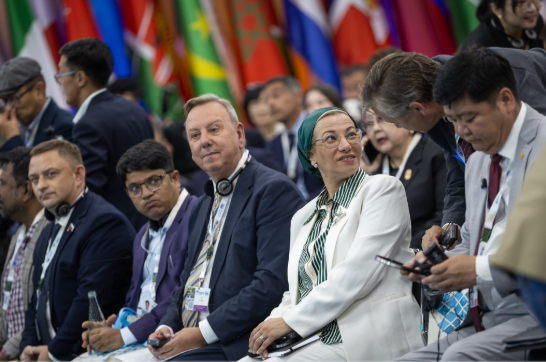
Discussions on the fund were advanced during the first Assembly of Partners of the RGDRP held at COP17.
Saudi Arabia, which founded the partnership, pledged $150m to the proposed pooled fund at COP16 in Riyadh.
The fund will be open to additional contributions from governments and development partners, including grants and official development assistance.
It is also expected to complement financing from development institutions and other partners, including a $2bn commitment made by the Islamic Development Bank and the OPEC Fund at COP16.
The first Assembly of Partners also marked a transition from setting up the partnership to operationalising its programmes, bringing together governments, development banks, UN agencies and private-sector organisations.
Deputy Minister of Environment of Saudi Arabia, Dr Osama Ibrahim Faqeeha, said investing in drought preparedness would help countries minimise losses when drought strikes.
“Drought resilience is an urgent necessity; every dollar invested in drought preparedness pays off many times over when drought strikes,” he said.
Faqeeha said the RGDRP was established as an umbrella for international collaboration aimed at strengthening drought resilience in vulnerable low- and lower-middle-income countries.
He said the partnership would help countries develop and implement drought resilience plans through stronger partnerships, innovation, knowledge sharing and capacity building.
New drought investment facility
Another major development was the launch of the Drought Resilience Investment Facility, DRIF, described as the first global catalytic financing platform dedicated to drought resilience.
The facility was launched during Water Day at COP17 and was co-created by the UNCCD and the Government of Luxembourg, with support from the International Drought Resilience Alliance.
The facility is designed to use public funds to reduce investment risks and attract larger volumes of institutional and private capital into drought-resilience projects.
Its areas of focus include water security, sustainable agriculture, nature-based solutions and land restoration.
Luxembourg’s Finance Minister, Gilles Roth, said his country’s €5m commitment to the facility was based on the belief that public funds could be used to unlock substantially larger private investments.
“Luxembourg’s EUR 5 million commitment to the Facility reflects a simple idea: public money can help bring much more private investment into areas where it is urgently needed,” Roth said.
He said the objective was to help transform promising drought-resilience initiatives into investable projects and take them to scale.
The Luxembourg Ministry of Foreign Affairs has also provided an initial $2m contribution towards establishing the facility.
Luxembourg’s Minister, Xavier Bettel, said the initiative would help channel investment into measures that reduce the vulnerability of communities, economies and ecosystems.
The facility aims to mobilise up to $400m in public and private capital.
It has also announced its first strategic partnership with the Global Environment Facility to explore ways of unlocking private and philanthropic finance through the GEF’s Blended Finance Programme.
New index to measure drought resilience
COP17 also witnessed the unveiling of Phase II of the International Drought Resilience Observatory, IDRO, described as the first global observatory dedicated to drought resilience.
Developed by the UNCCD, the Yale Center for Ecosystems and Architecture and partners under the International Drought Resilience Alliance, the platform builds on the pilot version launched at COP16.
The upgraded observatory is intended to help countries move beyond simply monitoring drought hazards to assessing their capacity to withstand and recover from drought.
At the centre of the platform is the world’s first Drought Resilience Index.
The index will enable countries to assess their ability to anticipate, prepare for and adapt to drought while identifying vulnerabilities and helping policymakers determine where investments are most urgently required.
The platform also incorporates artificial intelligence-powered features designed to help policymakers, technical experts and members of the public interpret complex drought-related information.
The current version features eight detailed country case studies covering five continents and has been opened for review by users globally.
Feedback from users will be used to further improve the platform.
The next phase will focus on working with countries that are members of the International Drought Resilience Alliance to determine how the index can be integrated into national decision-making and investment processes.
Spain’s Director-General for Biodiversity, Forests and Desertification, María Jesús Rodríguez de Sancho, said drought resilience could not be achieved through isolated interventions.
“As a Mediterranean country, Spain knows first-hand the economic, social and environmental costs of drought. Our experience has shown us that resilience cannot be built through isolated efforts,” she said.
Rodríguez de Sancho said Spain had invested in the development of IDRO and the Drought Resilience Index as part of efforts to shift from reacting to drought to proactively managing drought risks.
Africa and Nigeria face major implications
The developments at COP17 have particular relevance for African countries, where drought, desertification, land degradation and water scarcity continue to threaten food production, livelihoods and economic development.
Nigeria, like many countries in the Sahel and West Africa, faces increasing pressure from changing rainfall patterns, land degradation, desertification and water stress.
For communities dependent on rain-fed agriculture and pastoralism, improved early warning systems, drought-resilience planning and access to climate finance could play an important role in reducing the impacts of prolonged dry spells.
The emerging global financing architecture could also provide opportunities for countries such as Nigeria to develop investment-ready programmes rather than relying primarily on emergency responses after droughts have already caused significant damage.
The Drought Resilience Index could similarly provide policymakers with a more systematic basis for identifying vulnerable areas and directing resources towards preparedness, water security, sustainable agriculture and ecosystem restoration.
However, access to such opportunities would depend on the ability of national institutions to develop credible projects, mobilise domestic resources and meet the requirements of international financing institutions.
Speaking during the Ministerial Dialogue on Drought Resilience, Fouad warned against waiting until drought had developed into a full-scale crisis before taking action.
“We cannot continue to wait for drought to become a crisis before we act. We have the tools, partnerships and financial mechanisms to invest in preparedness, reduce losses and protect people and communities,” she said.
She said COP17 must deliver a strong outcome on drought supported by the resources required to translate international commitments into action at national and local levels.
According to her, drought resilience would ultimately be built within communities and landscapes rather than only through international declarations.
The host country, Mongolia, has also placed drought resilience at the centre of its COP17 priorities.
Mongolian Prime Minister, Nyam-Osor Uchral, called for a shift from commitments to measurable results.
“The biggest change we want to see from COP17 is a shift from words to action, from targets to implementation, and from commitments to measurable results,” he said.
Uchral called for drought resilience to be treated not only as an environmental concern but as a core component of development policy.
From emergency response to preparedness
The emerging architecture at COP17 reflects a broader shift in the global approach to drought management.
Rather than waiting for drought to trigger food insecurity, displacement, economic losses and humanitarian emergencies, the new initiatives seek to finance preventive measures and strengthen the capacity of countries and communities to withstand climate shocks.
For developing countries, the challenge will be turning the new global commitments into projects that deliver measurable benefits at the community level.
This includes strengthening water infrastructure, improving agricultural practices, restoring degraded land, expanding early warning systems, improving access to climate information and developing financial instruments that can protect vulnerable communities from drought-related losses.
The success of the initiatives will therefore depend not only on the volume of money pledged but on how quickly the financing reaches countries and communities most exposed to drought.
As COP17 continues, governments are expected to advance negotiations on drought governance and other issues under the UNCCD, while the new financing platforms and resilience tools provide practical mechanisms for implementing those commitments.
The developments in Ulaanbaatar signal an increasing recognition that drought resilience must be built before disaster strikes and that achieving it will require coordinated action involving governments, financial institutions, businesses, scientists and communities.
For countries such as Nigeria, the opportunity lies in ensuring that national drought and land restoration strategies are aligned with the emerging global financing and data architecture, while building the institutional capacity needed to convert international commitments into practical resilience on the ground.
By Dare Akogun