
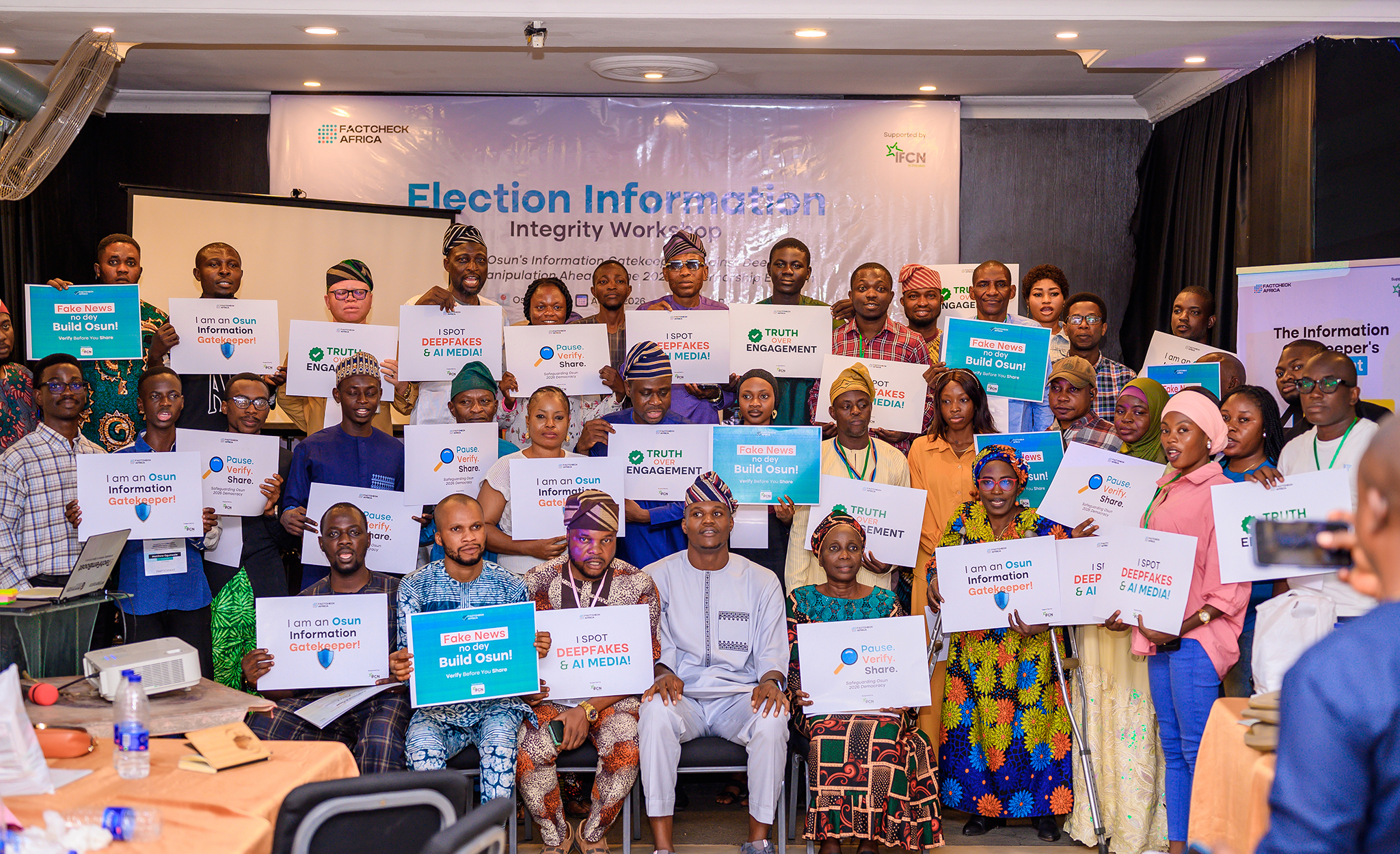
FactCheckAfrica (FCA), with support from the International Fact-Checking Network (IFCN) Sustainability Grant, has organised an election information integrity workshop to equip journalists, newsroom editors, bloggers and other information stakeholders with the skills to identify, verify and counter information disorder ahead of the 2026 Osun State governorship election.
The one-day workshop, themed “Preparing Osun Citizens and Information Stakeholders: Gathering 70 Newsroom Editors, Journalists, Bloggers and Other Information Producers Ahead of the 2026 Governorship Election,” was held on Saturday, August 8, 2026, at Osogbo Holiday Inn Hotel & Suites Ltd., Dada Estate, Osogbo, Osun State.
The workshop brought together 70 participants drawn from leading broadcast, print and digital media organisations across Osun State and Nigeria, reflecting the critical role of the media and other information producers in shaping public understanding of the electoral process.
Participants included representatives of prominent broadcast platforms such as the Nigerian Television Authority (NTA), Television Continental (TVC), Osun State Broadcasting Corporation (OSBC), Voice of Nigeria (VON), Federal Radio Corporation of Nigeria (FRCN), Rave FM/Western Spring Television and other radio and television stations across the state.
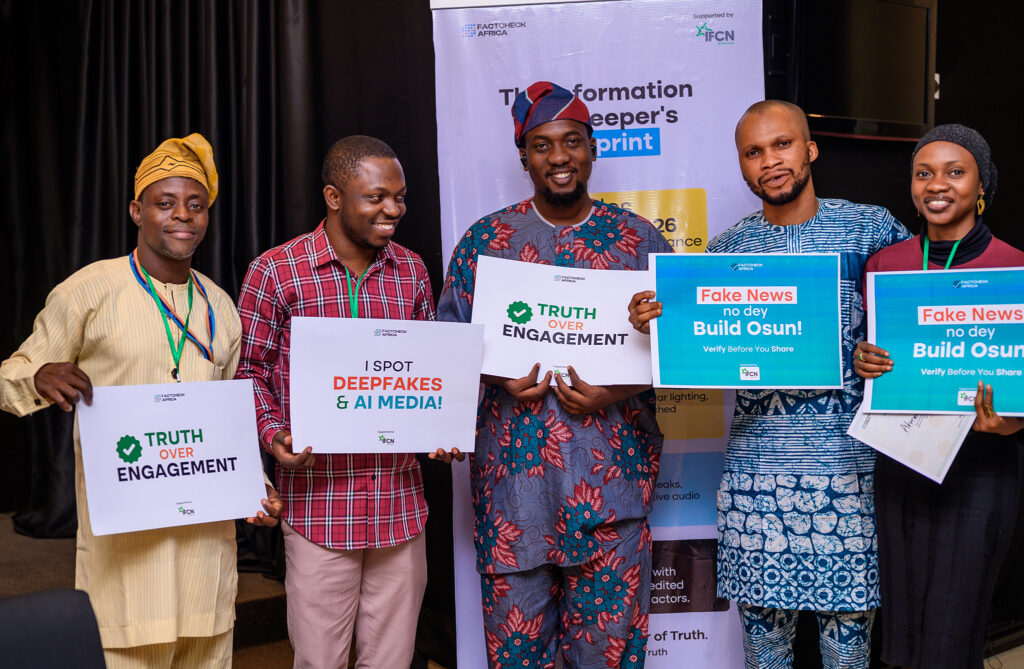
The print and news media were represented by major outlets including The Guardian, The Sun, The Nation, Vanguard, New Telegraph, Daily Sun, Daily Post, BusinessDay, Business Hallmark, Champion Newspapers and the News Agency of Nigeria (NAN), alongside several community and digital news platforms.
Also represented were key professional and stakeholder organisations, including the Joint National Association of Persons with Disabilities (JONAPWD), Nigeria Union of Journalists (NUJ), National Association of Women Journalists (NAWOJ) and the National Orientation Agency (NOA).
The workshop featured expert-led sessions on election misinformation and disinformation, fact-checking, source verification, responsible information sharing, artificial intelligence (AI), deepfakes and synthetic media, with participants taking part in practical exercises designed to strengthen their ability to identify and respond to information threats.
Understanding Election Information Disorder
Facilitating the opening session, Dr Rasheed Adebiyi, Associate Professor in the Department of Mass Communication at Fountain University, Osogbo, examined the nature of election-related information disorder and its implications for electoral integrity.
Adebiyi identified misinformation, disinformation and malinformation as three major forms of information disorder capable of undermining the credibility of elections.
He explained that misinformation involves the circulation of false information without an intention to cause harm, while disinformation refers to the deliberate creation or dissemination of false information with the intention of causing harm. Malinformation, he added, involves genuine or factual information that is deliberately presented or disseminated in a manner intended to cause harm.
The academic urged participants to cultivate a strong verification culture by examining available evidence, validating claims and assessing whether information serves the public interest.
According to him, election misinformation can erode public trust in the electoral process, suppress voter participation and heighten fear and tension among citizens.
He particularly cautioned journalists to scrutinise reports that appear to favour particular individuals, groups or organisations.
“When you see news reports that make certain entities beneficiaries, you should be wary. Challenge respectfully, report harmful lies and promote accuracy,” he said.
Fact-Checking and Verification Skills
Mustapha Lawal of FactCheckAfrica led a session on the fundamentals of fact-checking and verification, introducing participants to practical methods for establishing the accuracy and authenticity of information.
Lawal discussed source evaluation, claim assessment, reverse image searches, geolocation and other verification techniques journalists can deploy when investigating information obtained online.
He stressed that reporters must examine the truthfulness of a claim, assess the evidence supporting it and determine whether the evidence can be independently verified.
He also explained that opinions, value judgments and subjective statements generally cannot be subjected to the same factual verification process as objective and evidence-based claims.
Lawal urged journalists and other information producers to “think and verify before sharing information”, while demonstrating the use of digital verification tools including InVID, Google Lens, TinEye and Yandex.
AI, Deepfakes and Synthetic Media
The emerging threat of artificial intelligence, deepfakes and synthetic media to election information integrity was examined by Israel Olatunji Tijani, founder of ChatVE.
Tijani, a data scientist, introduced participants to AI-generated content, manipulated media and deepfakes, highlighting how advances in technology are making it increasingly difficult to distinguish authentic content from fabricated or manipulated material.
He engaged participants in practical exercises aimed at identifying different forms of information disorder and detecting potentially manipulated content.
According to Tijani, indicators of deepfake or manipulated content may include anatomical inconsistencies, functional implausibility, violations of physical laws involving shadows and reflections, and socio-cultural inconsistencies.
The session highlighted the importance of technological literacy among journalists as AI tools become increasingly capable of producing convincing fake audio, video and images that could be deployed to mislead voters.
Responsible Information Sharing
Lukman Adeoti, another facilitator at the workshop, addressed responsible information sharing during elections and encouraged journalists and other information producers to embrace the ọmọlúàbí code, which he associated with character, truthfulness, restraint and respect for community peace.
Adeoti also led participants through a practical exercise on preventing the spread of misinformation, challenging them to apply the knowledge gained from the workshop to real-world information scenarios.
The exercise focused on how journalists can pause, verify information, assess its potential consequences, and make responsible editorial decisions before publishing or sharing election-related content.
Participants Call for Sustained Engagement
Participants commended FactCheckAfrica for organising the workshop, describing the training as timely and relevant to the challenges facing journalists and other information producers ahead of the 2026 election.
Yinka Salami of Voice of Nigeria (VON) described the training as beneficial and called for sustained engagement between FactCheckAfrica and participating journalists beyond the election period.
“The content has been rather marvellous and beneficial,” Salami said.
He emphasised the importance of putting the AI and verification skills acquired during the workshop into regular practice.
“The usage of these AI tools, if it is not put into practice, you are likely to abandon it. So, in a way to ensure that we all become veterans through the training you have given to us, the relationship should continue,” he said.
Similarly, Bunmi Olaseinde of the National Orientation Agency urged FactCheckAfrica to make the initiative a periodic programme rather than limiting it to election periods.
Olaseinde noted that the previous programme of its kind in the state was held four years ago and called for more regular capacity-building initiatives to strengthen the ability of journalists and other information stakeholders to identify, verify and counter misinformation.
The workshop forms part of ongoing efforts to strengthen information integrity ahead of the 2026 Osun governorship election by equipping journalists, editors, bloggers and other information producers with practical skills to detect misinformation, verify claims, identify manipulated content and promote accurate, responsible and ethical election reporting.
By Eniola Amadu