

COP31 presents Australia with an opportunity to shape ambitious outcomes on the global transition away from fossil fuels and the scaling up of climate finance, while advancing practical industrial collaboration across the Asia Pacific and reinforcing the credibility of its renewable energy agenda.
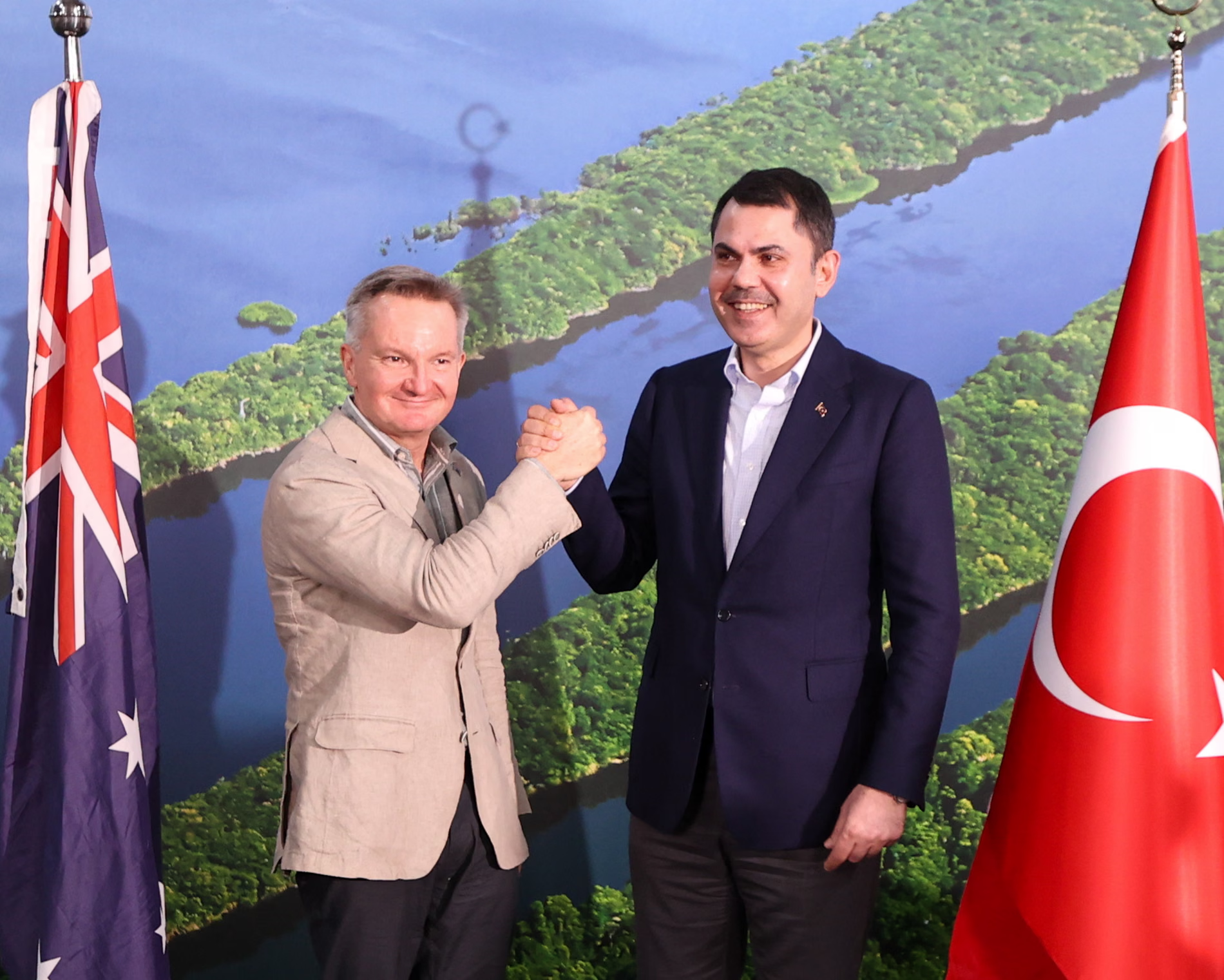
The 31st meeting of the United Nations Framework Convention on Climate Change Conference (UNFCCC) of the Parties (COP31) will be hosted by Türkiye in November 2026. Türkiye will serve as COP President while Australia’s Minister for Climate Change and Energy, Chris Bowen, will lead the negotiations.
In partnership with Pacific nations, Australia will co-convene a pre-COP leaders’ meeting focused on climate impacts and priorities in the Pacific. For many developing countries, climate change is an existential threat and is recognised as a potential ‘threat multiplier’, with negative impacts on peace and security. Key priorities should include a global agreement to phase out fossil fuel use and ambitious outcomes on climate finance, including the implementation of key decisions taken at COP30, held in Brazil in November 2025.
While the government has signalled its intention to lobby Saudi Arabia and other major fossil fuel producers not to obstruct progress on a fossil fuel phase-out, a key challenge to achieving a meaningful outcome will be the lack of participation of the United States, which has withdrawn from the Paris Agreement, the UNFCCC, and other international climate fora.
However, many US states remain engaged in climate action. In these circumstances, Australia should work with like-minded countries to achieve the most ambitious outcome possible. As Canadian Prime Minister Mark Carney said at the recent 2026 World Economic Forum Annual Meeting in Davos, ‘the middle powers must act together, because if we’re not at the table, we’re on the menu’.
COP30 outcomes included agreements to triple finance for adaptation by 2035 and, reflecting decisions taken at COP30, to ‘urgently advance actions to enable the scaling up of financing for developing country Parties for climate action from all public and private sources to at least USD 1.3 trillion per year by 2035’.
Parties also emphasised the ‘urgent need to remain on a pathway towards the goal of mobilising at least USD 300 billion for developing country Parties per year by 2035, for climate action, with developed country Parties taking the lead’. Australia should increase its contributions to the Green Climate Fund and the Fund for responding to Loss and Damage, while encouraging enhanced contributions from developed countries and higher-income developing countries, as well as commitments from non-state actors.
COP31 will also provide opportunities to strengthen engagement with regional partners seeking to decarbonise industrial supply chains while facing structural and financing barriers. As highlighted by Richard Neumann in his analysis of Japan’s efforts to decarbonise, Australia should encourage Japan to invest in critical minerals and metals extraction and processing in Australia, powered by renewable energy where possible.
The Republic of Korea has embraced nuclear power and is committed to transitioning away from coal. Australia should seek to convince POSCO to use green hydrogen from electrolysis powered by renewable energy for its proposed Pilbara iron ore project rather than fossil gas. Given potential Foreign Investment Review Board sensitivities regarding projects connected to the electricity grid, key priorities in the bilateral relationship with China include promoting exports of green iron and supporting solar PV manufacturing in Australia.
There is also potential to collaborate on the electrification of heavy transport in Australia, including fast-charging and battery-swapping hubs. Taiwan’s transition to a decarbonised economy is more challenging because it decided to phase out nuclear power early. Promoting the use of light-spectrum-optimised solar PV for greenhouses and floating offshore wind could assist Taiwan in its energy transition.
Australia’s priority in Southeast Asia should be to support multilateral power trading by expanding the ASEAN grid with new interconnections to increase the share of renewable energy, given the large number of existing thermal power stations with take-or-pay contracts.
There are also opportunities for Australia to collaborate with traditional partners on new and emerging technologies, such as green shipping. The recent failure of the International Maritime Organization meeting to agree on the net zero framework, under pressure from the US and other petrostates, could be an opportunity to factor in lower overall emissions by using wind-assisted ship propulsion technologies and propose and/or promote clauses in international agreements to support the electrification of ferry services.
While strong outcomes on the transition away from fossil fuels and solid progress toward scaling up finance from public and private sources for developing countries for climate action to at least USD 1.3 trillion per year by 2035 will be key priorities at COP31, promoting Australia’s renewable energy credentials and investment opportunities will be equally important to securing substantive and durable conference outcomes.
By Dr. Ruth Adler and Mr. Richard Neumann
————————————————————————————————————————————————————–
Dr. Ruth Adler is the President of Diplomats for Climate Ltd. Ruth is a former senior career officer of the Department of Foreign Affairs and Trade. Diplomatic appointments included Ambassador to Ireland (2013-2016) and High Commissioner to Brunei Darussalam (2006-2009), with earlier postings as Counsellor/Deputy Head of Mission at the Australian Embassy, Mexico City (1998-2000), and Second Secretary at the Australian Embassy, Manila (1991-1994).
She is also an Adjunct Researcher with the School of Law at the University of Tasmania. She holds a Doctor of Philosophy degree in international climate law and Latin American history and politics. She is the author of Financing Climate Justice: The Green Climate Fund in a Changing World (forthcoming, Edward Elgar Publishing Limited, UK, February 2026). She is also a graduate of the Australian Institute of Company Directors (GAICD).
Mr Richard Neumann is Chair of the Smart Energy Council Pacific Working Group and a member of the Advisory Council of the Franco-Australian Centre for Energy Transition at Swinburne University. Richard is a former diplomat who served overseas in Beijing, Seoul, and Taipei, and was Director of the Climate Mitigation and Investment Section in the Department of Foreign Affairs and Trade from 2019 to 2024.
He has a Master’s Degree in Foreign Affairs and Trade from Monash University, co-designed a Grid Integration of Renewable Energy Course with the Australian National University, and managed the Australia-Germany Hydrogen from Renewable Energy Supply Chain Feasibility Study with the University of New South Wales.
This article is published under a Creative Commons License and may be republished with attribution.