

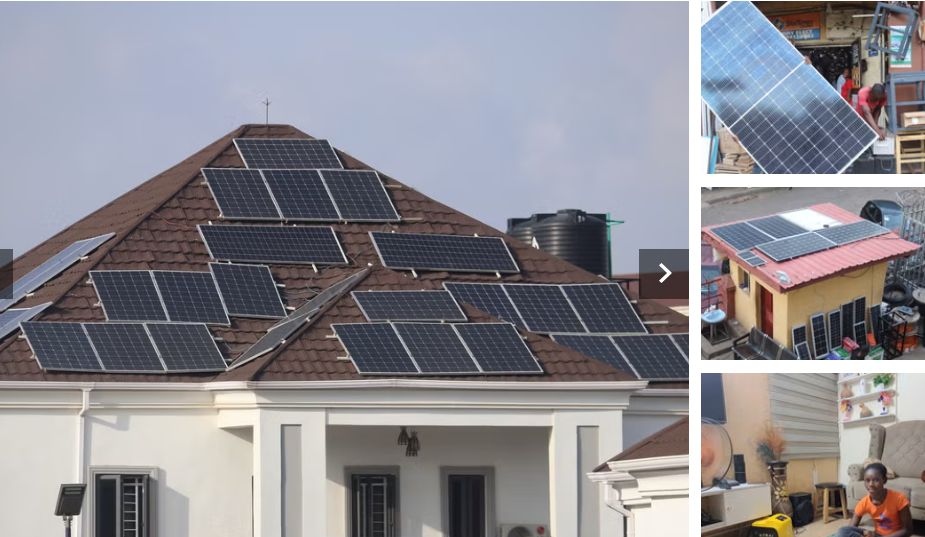
Nigeria has emerged as one of the leading markets for small-scale solar investment in Sub-Saharan Africa as rising electricity prices and unreliable power supply drive households and businesses towards renewable energy solutions, a new report by BloombergNEF has revealed.
The report, released on Wednesday, analysed clean energy developments across 16 Sub-Saharan African markets.
The report, titled ‘Sub-Saharan Africa Clean Energy Market Outlook 2026’, found that clean energy investment across the region reached a record $13.5bn in 2025, with Nigeria identified as one of the largest markets driving small-scale solar growth.
According to the report, economic considerations, rather than climate ambition or government policy, are increasingly the primary drivers of the region’s clean energy transition.
It said rising electricity prices had accelerated solar adoption in Nigeria, alongside South Africa and Kenya, as consumers and businesses seek alternatives to expensive and unreliable grid electricity.
It disclosed that the region installed 13 gigawatts of solar, wind and battery capacity in 2025, with annual additions projected to increase to 29GW by 2030.
Investment in small-scale solar more than doubled year-on-year to $8.5bn, according to the report.
It added that utility-scale renewable energy projects and small-scale solar-plus-battery systems were increasingly replacing petrol and diesel generators for homes and businesses because of their growing cost competitiveness.
The report further identified off-grid systems as the primary means of expanding electricity access in a region where more than 560 million people lacked reliable electricity in 2025.
Sub-Saharan Africa has also emerged as the fastest-growing destination for Chinese solar exports, accounting for 10.1 per cent of Chinese solar exports in the first quarter of 2026, up from 4.9 per cent during the same period a year earlier.
The findings have further highlighted Nigeria’s growing role in Africa’s clean energy market as the country struggles with persistent electricity supply challenges and the rising cost of petrol and diesel used to power generators.
Nigeria’s solar market has expanded rapidly in recent years, with households, businesses, public institutions and communities increasingly adopting solar photovoltaic systems, batteries and mini-grids to reduce dependence on the national grid and petrol- and diesel-powered generators.
The shift has been driven not only by environmental concerns but also by the economics of power generation. With businesses facing high energy costs and unreliable grid supply, solar systems are increasingly viewed as an investment that can reduce long-term operating expenses.
The trend is also reflected in the growing focus of the Federal Government and development partners on decentralised energy solutions, including solar home systems, mini-grids and other off-grid technologies aimed at expanding electricity access in underserved communities.
Nigeria’s energy transition is taking place against the backdrop of a wider effort to improve electricity access and attract private investment into the power sector. The World Bank recently endorsed a 2026–2032 partnership strategy for Nigeria, with a focus that includes improving access to energy and increasing private-sector investment.
For millions of Nigerians, particularly those outside the reach of reliable grid electricity, decentralised renewable energy has become a practical alternative to waiting for improvements in conventional power infrastructure.
Experts have also increasingly pointed to the economic benefits of solar mini-grids and off-grid systems, including improved productivity for small businesses, extended operating hours and reduced exposure to the volatility of petrol and diesel prices.
A study of solar mini-grids in rural Kenya and Nigeria found improvements in economic activity and productivity among connected households and businesses, highlighting the potential of decentralised renewable energy to deliver benefits beyond electricity access.
The BloombergNEF report comes as the continent’s clean energy market attracts increasing investment from international developers, financial institutions and equipment manufacturers.
BloombergNEF, a strategic research provider within Bloomberg, analyses global commodity markets and the technologies shaping the energy transition, including clean power, transport, buildings, industry, finance and emerging energy technologies.
The organisation says its research is used by governments, corporations, financial institutions and policymakers to understand investment, technology and policy trends affecting the transition to a lower-carbon economy.
While the report points to strong growth in clean energy investment, it also highlights the scale of Africa’s electricity challenge.
The continent continues to face a huge electricity access deficit, with unreliable power supply limiting industrialisation, job creation and economic growth.
For Nigeria, the growing solar market presents both an opportunity and a challenge. The opportunity lies in the country’s vast solar potential and its large population, which creates a huge market for solar panels, batteries, mini-grids and other clean energy technologies.
The challenge, however, is ensuring that the growth of the sector is supported by stable policies, access to affordable financing, quality standards and effective regulation to protect consumers and encourage long-term investment.
The BloombergNEF outlook suggests that Nigeria’s clean energy transition may continue to be driven less by climate commitments and more by the daily economic realities facing consumers and businesses.
As electricity prices rise and the cost of running petrol and diesel generators remains a major burden, solar power is increasingly becoming not just an environmental alternative but a financial necessity for millions of Nigerians.
BloombergNEF’s 2026 outlook projects that the combination of falling technology costs, growing demand for reliable electricity and expanding private investment could further accelerate the region’s clean energy transition through the end of the decade.
By Dare Akogun